7 Tactics to Scale Your Service Area Business to 5 Cities Without Getting Flagged
For service area businesses (SABs) – the plumbers, roofers, HVAC technicians, and landscapers who keep our infrastructure running – the dream is simple: dominate the local market. However, as any seasoned pro knows, the reality of google business profile seo is a minefield of proximity filters and strict verification protocols. You want to scale to five neighboring cities, but Google’s algorithm is designed to favor local proximity. If you push too hard without the right infrastructure, you hit the dreaded “Deceptive Content” flag, leading to immediate suspension.
The “SAB Scaling Dilemma” is a catch-22. To get more leads, you need to appear in the Map Pack for multiple cities. But to appear in those cities, Google traditionally wants to see a physical footprint. As a Google Business Profile Product Expert, I’ve seen countless businesses lose their entire digital presence by trying to “fake” their way into new territories. Scaling to five cities in 2026 requires a shift in mindset: Local SEO isn’t marketing; it’s infrastructure. You aren’t just placing ads; you are building a digital entity that has the authority to exist across a wider radius.
Tactic 1: Optimize the Primary Profile for a 2-Hour Radius
The first mistake most SABs make is failing to understand Google’s official stance on service areas. Google allows you to list up to 20 service areas on a single profile. However, there is a technical “soft cap” often referred to in the industry as the 2-hour drive time rule. Google’s documentation explicitly states that service areas should not extend further than about 2 hours of driving time from where your business is based.
When you attempt to How to Rebuild a Ranking Framework That Actually Holds Proximity, you must ensure your primary address (even if hidden) is the epicenter of a logical service circle. If you claim a city 4 hours away, the algorithm flags the profile for manual review. To scale to five cities successfully, those cities must fall within a realistic operational radius. If your five target cities are spread across a state, a single profile will never rank for all of them. You must cluster your expansion. For hybrid businesses (those with a physical office that also serve customers at their locations), the rules are even stricter regarding how you display your address versus your service area.
Tactic 2: Deploy Hyper-Local City Landing Pages
Since Google’s 2026 algorithm updates, the Map Pack is more tied to organic website signals than ever before. If you cannot have five verified physical offices, your website must do the heavy lifting to pull the Map Pin into those outlying areas. This is where city page seo becomes your most potent weapon.
A city landing page is not just a duplicate of your homepage with the city name swapped out. That is a recipe for “thin content” penalties. To rank higher on google maps, each city page must contain:
- Geo-specific service descriptions (e.g., “Emergency Roof Repair in [City Name] for Historic Homes”).
- Local landmarks and neighborhood mentions to build semantic relevance.
- Embedded Google Maps of the specific service area.
- Reviews from customers specifically located in that city.
By building these high-authority “City Clusters,” you prove to Google that your entity has a legitimate commercial interest and physical presence in that area, even without a unique GBP for every zip code. For more on this, see our guide on 7 Google Ranking Foundation Fixes for 2026 Hybrid Clusters. Utilizing robust google business profile seo strategies on your site is the only way to sustain rankings as you move away from your primary verification point.
Tactic 3: Geo-Specific Review Engineering
In the world of local search optimization, not all reviews are created equal. A review that says “Great service!” is a vanity metric. A review that says “The best plumber in [City Name], they arrived at my home in [Neighborhood] within 20 minutes” is a ranking signal. This is what I call geo-specific review engineering.
Google’s AI-driven sentiment analysis looks for “justification” signals. When a user in City B searches for your services, Google looks for reviews from other users in City B. If your profile only has reviews from your home city, your proximity strength dilutes the moment you cross the city line. You must actively encourage customers in your expansion cities to mention their location. This creates a “relevance bridge” between your hidden home office and the target expansion zone. Remember, Why Your Review Responses Are Failing the Local Search Test often comes down to a lack of localized keywords in both the review and your response.
Tactic 4: Building a “Fortress” of Localized Citations
Generic directories like Yelp and Yellow Pages are the bare minimum. To scale to 5 cities without getting flagged for “Deceptive Content,” you need a “Fortress” of localized citations. This means moving beyond the national sites and getting listed on city-specific business directories, local Chamber of Commerce sites, and neighborhood association blogs.
Google uses these citations to triangulate your business’s existence. If you claim to serve five cities, but your digital footprint is only found on a single national directory, the algorithm views your expansion as suspicious. You need local seo tools to identify niche-specific directories that are authoritative in your target expansion cities. Using a local seo tools suite allows you to audit where your competitors are mentioned and ensure your NAP (Name, Address, Phone Number) data is consistent across the entire five-city cluster. This consistency is the bedrock of google business profile optimization.
Tactic 5: Hyperlocal Backlink Infrastructure
If “Local SEO is infrastructure,” then backlinks are the steel beams. To move your map pin’s influence into a new city, you need digital “votes of confidence” from that specific geography. This is the most overlooked aspect of a gmb ranking service. Most agencies just buy guest posts on generic tech blogs. That does nothing for local proximity.
Instead, focus on:
- Sponsoring a little league team in your target expansion city.
- Getting a link from a local charity you’ve supported in that area.
- Partnering with a non-competing local business (e.g., a plumber linking to an electrician) for a “Local Home Pros” guide.
These hyperlocal links act as a GPS coordinate for Google’s crawler. When a high-authority site in [City 2] links to your [City 2] landing page, it validates your right to appear in the local Map Pack for that area. To master this, read How to get local backlinks that actually move your map pin. This is how you google maps ranking service your way to the top – by being a part of the local digital community.
Tactic 6: Navigating the 2026 Verification Minefield
The days of using a PO Box or a Virtual Office to trick Google are over. In 2026, Google’s verification process has become significantly more aggressive. Video verification is now the standard for SABs. You will likely be asked to film your equipment, your branded vehicle, and even your tools to prove you are a legitimate service provider.
If you try to scale to five cities by setting up five “fake” locations, you will be flagged. The “Deceptive Content” flag is often permanent. Instead, the safest way to scale is to maintain one highly authoritative, verified profile and use the “Service Area” settings combined with the organic tactics mentioned above. If you do decide to open a second physical location, it must be a real office with a lease and utility bills in the business name. Anything less is a gamble with your entire livelihood. For a full breakdown of the latest risks, check out A Survival Checklist for the Google Maps SEO 2026 Algorithm. To truly rank higher on google maps, you must play by the rules of entity verification.
Tactic 7: Advanced Proximity Tracking & Audit Tools
You cannot manage what you do not measure. To scale to five cities, you need to know exactly where your ranking “drops off.” Proximity is a gradient, not a binary. You might rank #1 in the center of your home city, but by the time you reach the suburbs of City 3, you’ve dropped to #14.
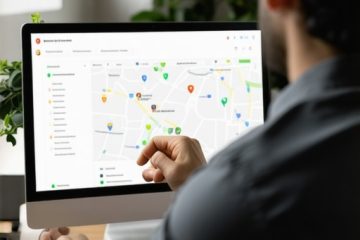
Using a google maps rank tracker or advanced local seo software allows you to see a heat map of your visibility. This data is crucial because it tells you where your “infrastructure” is weak. If you see a ranking dead zone in City 4, that is your signal to double down on localized backlinks and geo-specific reviews for that specific area. This iterative process of auditing and optimizing is what separates a stagnant business from a dominant regional powerhouse. For more advanced strategies, see 7 Maps SEO Strategy Fixes to Stop 2026 Radius Drops. Investing in the right local seo software is the only way to maintain a bird’s-eye view of your five-city empire.
Conclusion: The Infrastructure Approach to Scaling
Scaling a service area business to five cities is no longer about “gaming” the system; it’s about proving your relevance through a robust digital infrastructure. By optimizing your primary profile within a realistic radius, deploying hyper-local city pages, and engineering geo-specific signals through reviews and backlinks, you can dominate the Map Pack without the risk of suspension.
Google’s algorithm is getting smarter, but it still relies on clear signals of authority and proximity. If you provide those signals through legitimate, high-quality google business profile seo, the algorithm will reward you with visibility. Stop looking for shortcuts and start building the foundation your business deserves. Audit your current framework today and identify which of these seven tactics is the missing link in your expansion strategy.